Oct 15, 2025
Research Publication
Application Data Can Help Us Understand Hispanic Families’ Uptake of Child Care Subsidies




The Child Care and Development Fund (CCDF) is a federal program that provides financial assistance to help families with low incomes pay for child care so parents can work, receive job training, or pursue educational opportunities—activities that support families’ economic security and mobility. While CCDF serves approximately 1.3 million children under age 13 each month, research indicates that Hispanic1 families’ participation in the program differs considerably by state and may not reflect their representation among eligible populations.
Nearly half (47%) of Latino children under age 13 live in families with low incomes,2 despite strong labor force participation among Hispanic families. This combination of low income and high employment means that Latino families represent a significant share of families who are likely eligible for child care subsidies. Hispanic families vary considerably across multiple dimensions, including their specific Hispanic ancestry/heritage, their primary (or preferred) language spoken at home, their English-speaking proficiency, their time spent in the United States, and their educational background. This variation likely affects Hispanic families’ engagement with and participation in CCDF programs. Collecting data on these characteristics can help states better understand how these dimensions affect participation and inform service delivery.
Drawing on data from state CCDF application forms, this brief examines two key questions.
- First, do the demographic data elements collected through state CCDF applications capture the multiple dimensions of variation within Hispanic communities that may affect their program participation?
- Second, do state CCDF applications’ design and accessibility features facilitate or hinder Hispanic families’ enrollment and the accurate collection of data?
To answer these questions, we analyze practices in 14 states with large populations of Hispanic children in households with low incomes (Arizona, California, Colorado, Florida, Georgia, Illinois, Nevada, New Jersey, New Mexico, New York, North Carolina, Pennsylvania, Texas, and Washington; hereafter referred to as “Hispanic-populous states”)—a population likely eligible for subsidies. This analysis focuses specifically on demographic information collected through CCDF application forms available via state websites. States may have access to additional demographic information through other administrative data sources that are not examined in this brief. This analysis can help states and federal agencies identify promising practices and areas for improvement to ensure that application-based data collection effectively supports program access and service delivery for eligible families.
Findings
States vary in the demographic data collected in CCDF application forms
Demographic data collected via CCDF application forms can provide valuable information regarding eligible families’ access to and participation in subsidy programs, inform service delivery to better meet families’ needs, and assist with federal reporting.
Nearly all Hispanic-populous states collect application data on children’s ethnicity and race, but some mark these fields as optional rather than required. While most states (93%, or 13 of 14 states reviewed) collect data on child ethnicity and race as required for federal reporting, some mark these fields as optional rather than required or allow participants to indicate that they prefer not to answer (see Figure 1). The state that does not collect data on the ethnicity and race of the child does ask for this information about the parent, although the question is marked as optional. Note, however, that states may have other sources of this information beyond application data.
Many states collect information on primary language spoken at home, another required element for federal reporting. About 64 percent of states’ application forms (9 of 14 reviewed) include questions related to the primary language spoken in the household (see Figure 1), although practices vary in how this information is requested. Of the nine states that ask about language, two ask about respondents’ “preferred language” (1 state) or “native language” (1 state) rather than “primary language.” Two states ask the respondent their preferred language for receiving information in addition to asking about the primary language spoken in the household.
Figure 1. Most Hispanic-populous states collect data on children’s race and ethnicity in applications, although some categorize these fields as optional
Percent of Hispanic-populous states that collect information on child ethnicity and race and primary language spoken in the home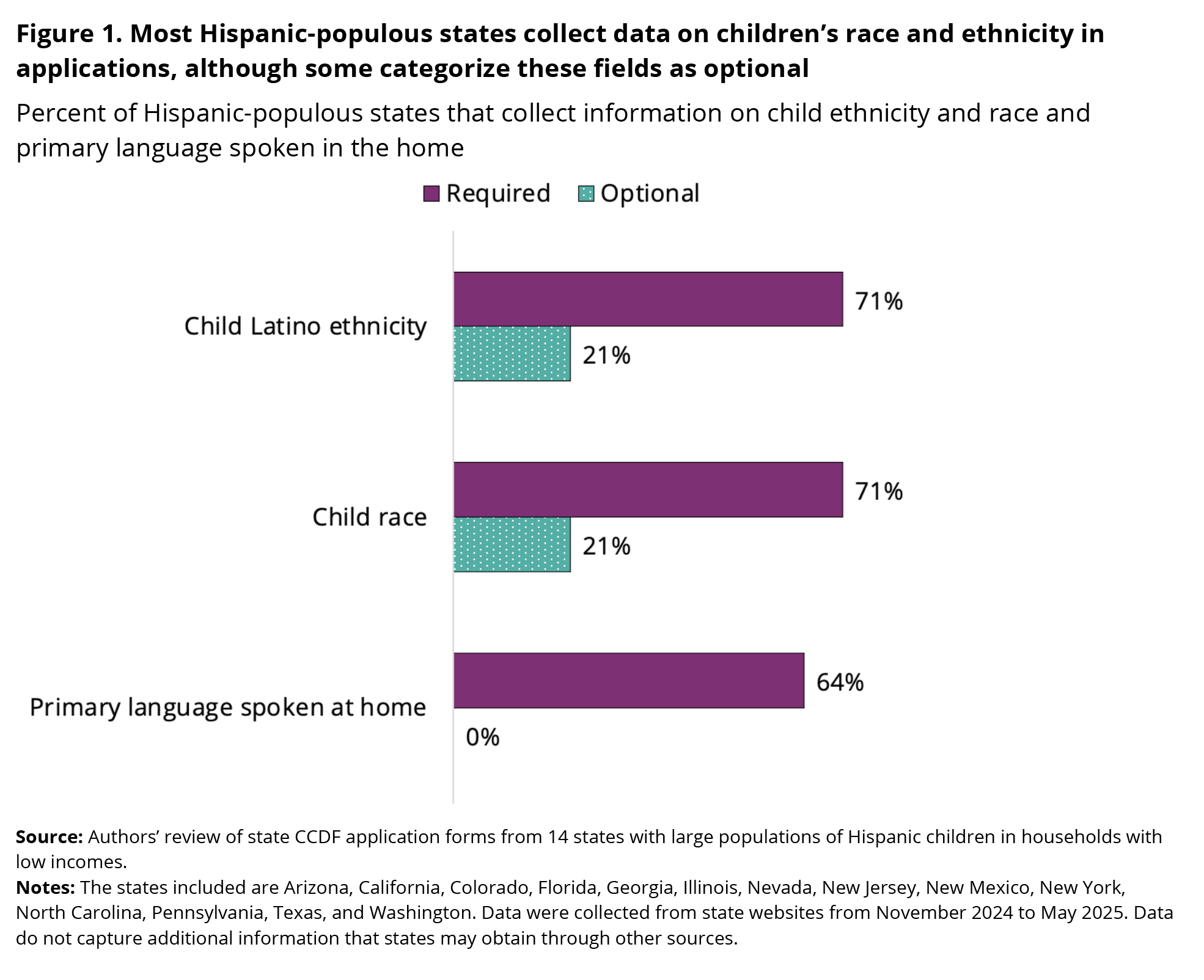
Hispanic-populous states vary widely in whether they collect additional information—beyond federal requirements—that might help them better understand the Hispanic families who apply for and receive child care assistance. Nearly three quarters of states (71%; 10 of 14 reviewed) ask whether the child is a U.S. citizen or legal resident. Forty-three percent (6 of 14) have a question specifically about whether the child is a U.S. citizen and 93 percent (13 of 14) ask for a child’s Social Security number, although most (9) indicate that this question is optional. One state collects information about the child’s country of origin; no states collect information about Hispanic ancestry or heritage (e.g., Mexican, Puerto Rican, or Cuban heritage).
States’ design and delivery of CCDF application materials also varies
In addition to which data elements each state collects, the ways in which states design and deliver application materials can affect both program participation and the quality of demographic information gathered. The accessibility of application processes—including mode of application and language supports offered—may influence whether families fill out applications and provide complete demographic information.
Hispanic-populous states vary in application modes offered, which may affect accessibility for Latino families. More than half of the states (57%; 8 of 14 reviewed) offer both online and traditional application methods (in-person, email, mail, etc.), while 21 percent (3 states) offer traditional methods only and 21 percent (3 states) provide only online options, according to the information available on the states’ websites (see Figure 2). This variation may be important for Latino families who face digital access barriers or need in-person assistance.
Figure 2. Hispanic-populous states vary in offering traditional, online, or both modes of application
Percent of Hispanic-populous states that provide CCDF application through traditional modes (e.g., mail, email, in-person, fax), online, or both

Source: Authors’ review of state CCDF application forms and websites from 14 states with large populations of Hispanic children in households with low incomes. The states included are Arizona, California, Colorado, Florida, Georgia, Illinois, Nevada, New Jersey, New Mexico, New York, North Carolina, Pennsylvania, Texas, and Washington. Data were collected from state websites from November 2024 to May 2025. Percentages do not add up to 100 due to rounding. States may offer additional modes to apply that are not reflected on their websites.
Many Hispanic-populous states have combined applications for CCDF and other programs. More than half of the states (57%; 8 of 14) included CCDF as part of a combined application through at least one application mode (usually through their portal-based application option). A combined application allows families to complete one application for both CCDF and at least one other program (e.g., nutrition or cash assistance or Medicaid), facilitating easier access to a comprehensive set of supports that include child care assistance for eligible families.
Among Hispanic-populous states, nearly all provide Spanish translations of application materials and website information, but few demonstrate alertness to whether the source material’s reading level is suitable for all readers. All states reviewed provide Spanish translations of application forms online and nearly all (93%; 13 of 14) offer readily accessible Spanish translations of website information (see Figure 3). However, the grade level required to understand the English version of the application materials (as measured by the Flesch-Kincaid Grade Level readability formula) varies widely, from 6th grade to advanced college (see Figure 4). Three states use symbols or visual aids to ease literacy demands (see Figure 3).
Figure 3. Most Hispanic-populous states provide Spanish translations of CCDF application materials and website information
Percent of Hispanic-populous states that provide language and readability supports

Figure 4. Hispanic-populous states vary in the grade level required to understand the English version of the application materials
Percent of Hispanic-populous states with application materials that are understandable with an average, high, and very high reading level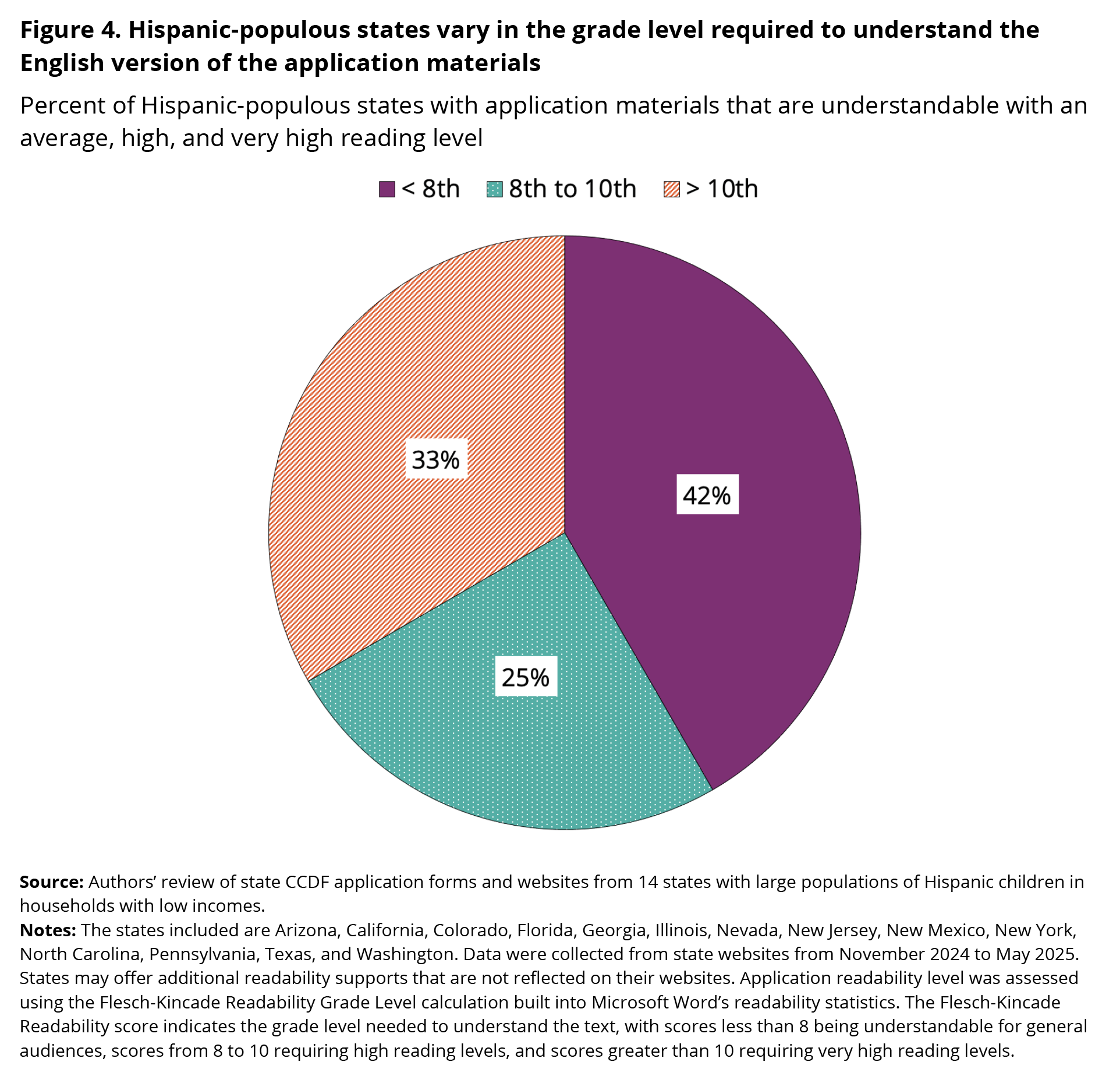
Summary and Implications
The ability of application-based data collection to adequately capture demographic information about Hispanic families is critical for program planning, monitoring, and improvement, and to inform effective service delivery that meets families’ needs.
Our analysis reveals that states generally collect the basic demographic information required for federal reporting—such as child race, ethnicity, and primary language spoken at home—through their application forms. However, there are significant variations in the data collected via CCDF application forms that could affect researchers’ and policymakers’ understanding of Latino families’ participation in CCDF. States also vary considerably in the degree to which their application forms collect additional demographic data beyond federal requirements. While most collect information on whether a child is a U.S. citizen or legal permanent resident, very few gather data on elements that are important for understanding CCDF participation patterns within Latino subgroups, such as country of origin or specific Hispanic heritage subgroups.
Most states provide Spanish translations of application materials and website information, but comprehensive language accessibility—including visual aids—remains limited. The reading level of application materials (33% of states in our sample require above a 10th-grade reading level) may pose additional challenges for families with lower levels of formal education or English proficiency.
The variation in data collected via applications across states makes it difficult to develop a comprehensive national understanding of participation patterns among different Hispanic subpopulations or the U.S. Hispanic population in general. This challenge is compounded by the fact that some states mark population-specific questions as optional, potentially resulting in incomplete data for analysis and program planning purposes. High levels of missing data could significantly limit the utility of this information for understanding participation patterns and refining strategies to improve access. Additional research examining the actual quality and completeness of these data—including research to understand why information may be missing, how data collection processes affect accuracy, and what alternative data sources states may be able to access—will be essential for determining how states can most effectively compile and use demographic information for program planning and evaluation.
Importantly, application-based data collection practices do not operate in isolation; rather, they also affect families’ experiences interacting with programs and ultimately affect the quality and completeness of the information available for program improvement. For example, limited language accessibility may affect not only program participation and families’ experiences with program staff but also the accuracy and completeness of demographic data collected. Lead agencies seeking to improve their understanding of Latino families’ participation in CCDF should consider the interconnected nature of these practices.
States seeking to enhance their application-based data collection to better understand and serve Latino families should consider implementing multiple strategies simultaneously, recognizing that improvements in one area (such as language accessibility) may support improvements in others (such as data quality and completeness).
Footnotes
1 We use the terms “Hispanic” and “Latino” interchangeably throughout the brief. Consistent with the Office of Budget and Management’s (OMB) standards for data on race and ethnicity, these terms refer to individuals of Mexican, Puerto Rican, Salvadoran, Cuban, Dominican, Guatemalan, and other Central or South American or Spanish cultures or origins.
2 Alvira-Hammond, M. (2025). Unpublished analysis of the 2023 ACS 1-year estimates obtained via IPUMS USA, University of Minnesota, www.ipums.org. Child Trends.
Suggested Citation
Thomson, D., Guzman, L., Ramirez, L., & Falletta, K. (2025). Application data can help us understand Hispanic families’ uptake of child care subsidies. National Research Center on Hispanic Children & Families. https://doi.org/10.59377/583e1078d
Acknowledgements
The authors would like to thank the Steering Committee of the National Research Center on Hispanic Children & Families—along with Kristen Harper, Laura Ramirez, Katy Falletta, and Ana Maria Pavić—for their helpful comments, edits, and research assistance at multiple stages of this project. The Center’s Steering Committee is made up of the Center investigators—Drs. Natasha Cabrera (University of Maryland, co-PI), Danielle Crosby (University of North Carolina at Greensboro, co-PI), Lisa Gennetian (Duke University, co-PI), Lina Guzman (Child Trends, PI), Doré LaForett (Child Trends, co-I), Julie Mendez (University of North Carolina at Greensboro, co-PI), and Maria Ramos-Olazagasti (Child Trends, deputy director and co-PI)—and federal project officers Drs. Jenessa Malin and Kimberly Clum (Office of Planning, Research and Evaluation).
This brief is supported by Grant Number 90PH0032 from the Office of Planning, Research & Evaluation within the Administration for Children and Families, a division of the U.S. Department of Health and Human Services totaling $7.84 million with 99 percentage funded by ACF/HHS and 1 percentage funded by nongovernment sources. Neither the Administration for Children and Families nor any of its components operate, control, are responsible for, or necessarily endorse this brief. The opinions, findings, conclusions, and recommendations expressed are those of the author(s) and do not necessarily reflect the views of the Administration for Children and Families and the Office of Planning, Research & Evaluation. For more information, please visit the ACF website, Administrative and National Policy Requirement.
Editor: Brent Franklin
Designers: Krystal Figueroa and Joseph Boven
About the Authors
Dana Thomson, MS Ed., PhD, work focuses on services and programs that have the potential to strengthen child and family well-being, particularly for those experiencing economic hardship. She was previously a research scholar at Child Trends and is now a senior behavioral and social scientist at RAND.
Lina Guzman, PhD, is the principal investigator and director of the National Research Center on Hispanic Children & Families. She is also chief strategy officer at Child Trends and serves as the director of the Child Trends Hispanic Institute. Her research focuses on describing the characteristics and experiences of diverse communities of Latinos living in the United States to inform policies and programs.
Laura Ramirez is a senior research assistant at Child Trends who provides project assistance for the National Research Center on Hispanic Children & Families. She supports the Center’s research activities to better serve Hispanic children and families with low incomes.
Katy Falleta, MPH, is a research scientist at Child Trends. Her research focuses on programs that support families with young children and community engagement in programs and research. She supports Building Capacity Activities for the National Research Center on Hispanic Children & Families.
About the Center
The National Research Center on Hispanic Children & Families (Center) conducts research to inform programs and policy to better serve Hispanic children and families with low incomes. Our research focuses on poverty reduction and economic self-sufficiency; child care and early education, including federal programs such as Head Start (HS) and the Child Care and Development Fund (CCDF); and cross-cutting topics that include parenting, family structure, and family dynamics. The Center is led by Child Trends, in partnership with Duke University, University of North Carolina at Greensboro, and University of Maryland, College Park.
Copyright 2025 by the National Research Center on Hispanic Children & Families.
Appendix
Table 1. Variation in Key CCDF Data Collection Practices Across 14 States with Large Populations of Hispanic Children
 Source: Authors’ review of state CCDF application forms and processes for 14 states with large populations of Hispanic children in households with low income (below 200% FPL).
Notes: Data were collected from state websites from November 2024 to May 2025. States may offer additional readability supports that are not reflected on their websites.
*Traditional application methods refer to applications submitted in-person or by email, mail, or fax.
**Some applications ask whether a child is a US citizen or a qualified immigrant, so it can be inferred that the child is a legal resident but not necessarily a US citizen. Other applications ask separate questions regarding legal residency and US citizenship..